Praise be to Jesus now and forever.
This blog is almost 9 years old with around 49k hits! :)
The archive of posts is located just below the Song of the Fortnight gadget.
Subscribe to get the latest posts via email from the right pane.


Disclaimer:
This site uses cookies and you accept that by continuing to use the site that you agree to this.
You are currently hearing the audio from the Song of the Fortnight gadget in the right pane.
All the content belongs to their respective owners. I own nothing.
The posts you see on this blog are not entirely my work. Credit has been attributed wherever possible.
I have not used any ad service on this website.


Info2

Click here for a list of all posts related to Christmas.


Click here for Christmas messages

Search This Blog

Blog Archive

Friday, May 23, 2014

Maximilian Kolbe - A Life in the Way of his Master


http://t0.gstatic.com/images?q=tbn:ANd9GcT-ArU_1ou5Toi3e_T-pPpm3FKoW6kzpy3vni4BAKQq6rOtQLecpAIMe07-kQ

Maximilian Kolbe was a Catholic priest, who was put in a Nazi concentration camp for his faith.
On May 28, 1941, he was transferred to the concentration camp at Auschwitz.

During his time there, he would share his meagre rations of food with those around him who were hungry. Despite the evil in the camp perpetrated against the inmates, Kolbe pleaded with the prisoners to forgive their persecutors and overcome evil with good.

A protestant doctor who treated the patients in Kolbe’s block said that Kolbe would not let himself be treated before any other prisoners in that block.
He sacrificed himself for the other prisoners.

 The doctor said about Kolbe:
"From my observations, the virtues in the Servant of God were no momentary impulse such as are often found in men, they sprang from a habitual practice, deeply woven into his personality."

http://upload.wikimedia.org/wikipedia/ro/thumb/4/40/Maximilian_Kolbe.jpg/250px-Maximilian_Kolbe.jpg

One day a man in Kolbe’s block escaped. All of the men from that block were brought out into the hot sun and made to stand there all day with no food or drink.

At the end of the day, the man that had escaped was not found and so Fritsch, the Nazi commandant told the prisoners that ten men would be selected to die in the starvation cell in place of the one that had escaped. One man, a polish sergeant (Francis Gajowniczek) was one of those selected. He begged to be spared because he was worried that his family would not be able to survive without him.

As he was pleading with the commandant, Maximilian Kolbe silently stepped forward and stood before the commandant.
The commandant turned to him and said asked,

"What does this Polish pig want?"
Kolbe pointed to the polish sergeant and said,

 "I am a Catholic priest from Poland; I would like to take his place, because he has a wife and children."

The commandant stood silent for a moment in disbelief. He then allowed the sergeant to go back to his place in the ranks and Kolbe took his place in the starvation bunker. Each day the guards removed the bodies of those who had died.

http://saints.sqpn.com/saintm01.jpg

However instead of the usual sounds of screaming, all they could hear was the sounds of Kolbe and the others in the bunker singing hymns and praying.
When Kolbe couldn’t speak any longer due to hunger and lack of energy, he would whisper his prayers.

After two weeks, the cell had to be cleared out for more prisoners.
Only four prisoners were left and Kolbe was one of them.

The guards injected each with a lethal injection and on August 14, 1941, Kolbe paid the ultimate price.
Kolbe viewed others as more important than himself.

And in that he was following the Master.

http://t2.gstatic.com/images?q=tbn:ANd9GcQ-mPYOghcQIl5sb0lG_aAnFxKKABkeJGFDbrC1UaxWweg3XvtUG_EWMYsr

Sunday, April 13, 2014

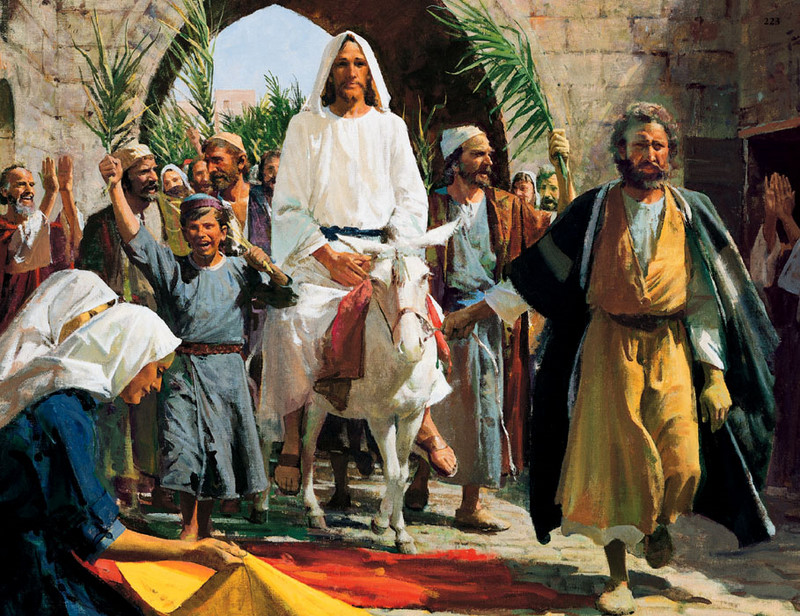
Palm Sunday!

Praise be to our Lord Jesus now and forever :)
This blog is turning 5 today, the very first post being about Palm Sunday itself.

Click here to see the post from 2009.

Sunday, March 30, 2014

Keeping Pride in Check

March 28, 2014 - Rabbi Yechiel Eckstein, Holy Land Moments


Now Naaman was commander of the army of the king of Aram. He was a great man in the sight of his master and highly regarded, because through him the LORD had given victory to Aram. He was a valiant soldier, but he had leprosy.
— 2 Kings 5:1


The Torah portion for this week is Tazria, which means “to conceive,” from Leviticus 12:1–13:59, and the Haftorah is from 2 Kings 4:42–5:19.

This week’s Haftorah is the story of a proud man who was humbled. As it says in Proverbs 11:2,“When pride comes, then comes disgrace, but with humility comes wisdom.”

The story takes place just after Israel had suffered defeat at the hands of Aram. Ahab, the king of Israel, had been killed by an Aramean archer, Naaman, who scored a direct shot at Ahab’s heart. This success quickly catapulted Naaman to fame, and he became chief of the Aramean army. However, his victory was soon overshadowed by an acute personal problem. Naaman was afflicted with tzara’at, the very same defiling skin disease discussed in this week’s Torah reading.

The Sages explain that the root cause of tzara’at is arrogance. Haughtiness often manifests itself in gossip, frequently cited as the sin that led to tzara’at. However, at the core, the spiritual malady is pride. In Naaman’s case, his success in killing the king of Israel led him to arrogance. He considered himself the greatest warrior in the world. But it was God who directed Naaman’s arrow into Ahab’s heart. The Haftorah we read at this time relates how God cured Naaman both of his pride and his skin disease.

This first step in breaking Naaman’s pride was afflicting him with tzara’at. Not many things are as humbling as being afflicted with an uncomfortable, ugly disease. Next, the solution to Naaman’s problem came from his slave – a young Israelite girl – who suggested that Naaman go to Israel to be cured, essentially forcing the great general to turn to his enemy for help.

Then, upon seeking out the Israelite prophet, Elisha, he was seen only by Elisha’s servant who advised Naaman to dip in the Jordan River seven times for a cure. At first, Naaman was angered by what he considered stupid advice. However, he eventually complied, dipped himself in the Jordan, and was indeed cured – not just of the skin disease, but also of his pride.

I once heard the following advice for putting pride in its place — take pleasure in our achievements instead of being prideful. If I gave you a check for a lot of money and you deposited it into the bank, would you be proud of yourself? Of course not! You had not earned it yourself, but you also would be foolish not to deposit it!

Similarly, God has gifted us all with talents and abilities. He has guided us toward our achievements. These are the things that we can take pleasure in without falling into the trap of arrogance when we recognize that everything has been given to us by God. It’s not us, but God who is deserving of glory. All we can ever do is “cash the check” He has given us and be grateful for His blessings.


Your Gift of One Food Box Makes a Difference


Thursday, March 20, 2014

What Silence Says

Post from Holy Land Moments Daily Devotional, March 19, 2014 by Rabbi Yechiel Eckstein

Moses then said to Aaron, “This is what the LORD spoke of when he said: ‘Among those who approach me I will be proved holy; in the sight of all the people I will be honored.’” Aaron remained silent. — Leviticus 10:3

The Torah portion for this week is Shemini, which means “eighth,” from Leviticus 9:1–11:47, and the Haftorah is from 2 Samuel 6:1–7:17.

Sometimes in life we struggle to find the right words to say. However, at other times, the challenge is to say nothing at all. In this week’s Torah portion, we read about one of those times.


It was the eighth day of the Tabernacle’s inauguration in what should have been the most joyous day of Aaron’s life. He had been anointed as the High Priest, and the first offerings he made to God had been consumed by a divine fire sent from the heavens. The day marked the beginning of divinely ordained worship that connected humanity to God in a way never before experienced, and Aaron stood at the forefront.

Then, in the midst of the celebrations, tragedy struck. Aaron’s two sons, among the most righteous men of their generation, came before God with an offering. And because they did so without permission or authority, they were killed instantly.

If ever there was a time to express outrage, this was the time. If ever a person had reason to complain to God, this was the time. However, Scripture tells us, “Aaron remained silent.” Aaron’s silence was more eloquent than a thousand words.

The Sages explain that Aaron’s silence was an expression of acceptance. Aaron could have argued with God; he could have complained about his tragic lot on what should have been a joyous occasion. But his silence implied that he did not question God’s ways. As incomprehensible as they might seem, Aaron accepted that God’s ways were just and good – no matter what.

From where did Aaron obtain this almost super-human ability to trust unwaveringly in God?

Take a look at Aaron’s life experiences. Imagine young Aaron growing up a slave in Egypt. As a child he learned that Pharaoh had issued a decree that all baby boys were to be drowned in the Nile River. His mother became pregnant and gave birth to a son. Aaron must have wondered how God could allow a baby to be born only to be killed so cruelly. It all seemed so tragic, so wrong!

However, Aaron also witnessed how his mother, in order to keep her infant son alive, placed him in a basket afloat on the river. The baby was then discovered by Pharaoh’s daughter, who took him home and raised him as her own son in Pharaoh’s palace. This child eventually became the savior of Israel. What had seemed like a terrible tragedy became a great blessing!

Through his silence, Aaron teaches us a powerful lesson for our lives. We don’t always see the big picture and we can’t understand God’s ways. But God is always good, “his way is perfect” (Psalm 18:30). We might not understand God’s ways, but our silence expresses our faith in Him.


Wednesday, February 19, 2014

The Parable of the Pencil


In the beginning, the Pencil Maker spoke to the pencil saying, "There are five things you need to know before I send you out into the world. Always remember them and you will become the best pencil you can be." This is what was said.

1. You will be able to do many great things, but only if you allow yourself to be held in Someone's hand.
2. You will experience a painful sharpening from time to time, but this is required if you are to become a better pencil.
3. You have the ability to correct any mistakes you might make.
4. The most important part of you will always be what's inside.
5. No matter what the condition, you must continue to write. You must always leave a clear, legible mark no matter how difficult the situation. 

The pencil understood, promising to remember, and went into the box fully understanding its Maker's purpose.

Now replacing the place of the pencil with you; always remember them and never forget, and you will become the best person you can be.

1. You will be able to do many great things, but only if you allow yourself to be held in God's hand. And allow other human beings to access you for the many gifts you possess.
2. You will experience a painful sharpening from time to time, by going through various challenges, but you'll need it to become a stronger person.
3. You will be able to correct mistakes you might make and grow through them.
4. The most important part of you will always be what's on the inside.
5. On every surface you walk, you must leave your mark. No matter what the situation, you must continue to serve your higher purpose in life. 

Everyone is like a pencil... created by the Maker for a unique and special purpose.

By understanding and remembering, let us proceed with our life on this earth having a meaningful purpose in our heart.